
The 17th International Seminar on Polymer Science and Technology, ISPST 2026, will highlight three special topics alongside its main scientific themes: Artificial Intelligence Applications in Polymers, Circular Economy in Polymers, and Advanced Polymers with High Added Value.
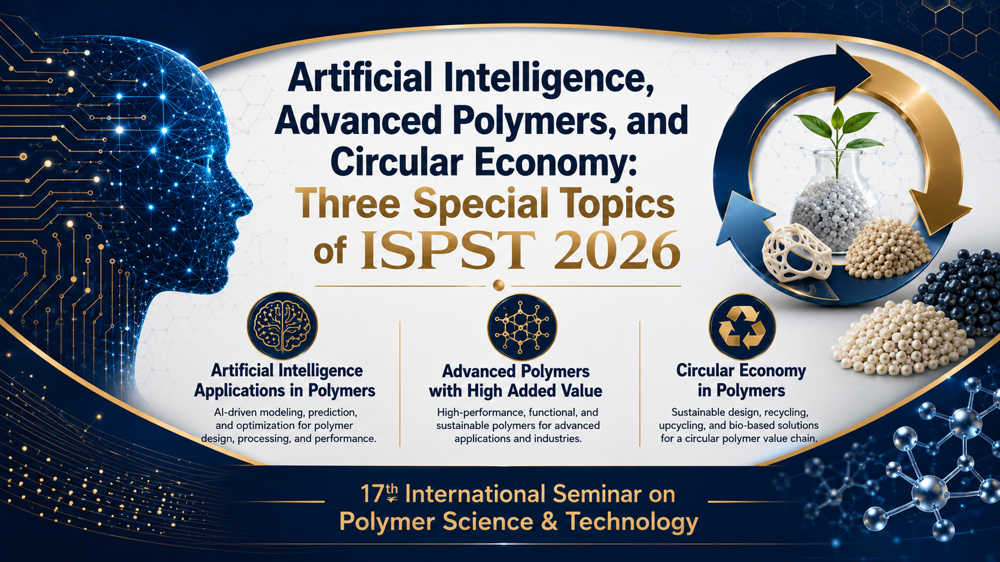
The 17th International Seminar on Polymer Science and Technology, ISPST 2026, will be held with a focus on the latest achievements, challenges, and emerging trends in polymer science and technology. In addition to its main scientific topics, this edition of the seminar will highlight three forward-looking, application-oriented, and industry-relevant special topics: Artificial Intelligence Applications in Polymers, Circular Economy in Polymers, and Advanced Polymers with High Added Value.
Artificial intelligence is becoming an increasingly important tool in polymer science and technology. AI-based approaches can support data analysis, prediction of polymer properties, process optimization, design of new polymer structures, modeling of material behavior, and acceleration of scientific research. This topic reflects the growing connection between digital technologies, data-driven methods, and the development of advanced polymeric materials.
Circular economy in polymers is another key topic in the path toward sustainable development and better resource management in the polymer industry. This approach emphasizes waste reduction, reuse of materials, recycling, sustainable product design, extending the life cycle of polymeric products, and reducing environmental impacts. Addressing circular economy strategies can support the development of greener, more responsible, and environmentally compatible technologies in polymer science and engineering.
The third special topic, Advanced Polymers with High Added Value, focuses on the development of innovative polymeric materials with improved performance, specialized applications, and stronger industrial potential. This area may include advanced polymers for medical, biological, energy, electronic, packaging, automotive, aerospace, functional coating, and other high-tech applications. Highlighting this topic shows that ISPST 2026 gives special attention not only to fundamental scientific research, but also to the industrial and economic value of advanced polymeric materials.
By focusing on these three special topics, ISPST 2026 highlights the importance of innovation, sustainability, data-driven technologies, and the development of high-value polymeric materials in the future of polymer science and industry. The seminar aims to provide a platform for scientific exchange, presentation of innovative research, and collaboration among researchers, academics, students, and