
History of the International Seminar on Polymer Science and Technology
The International Seminar on Polymer Science and Technology, ISPST, is one of the long-standing scientific events in the field of polymer science, engineering, and technology in Iran. The seminar was first established in 1986 with the aim of providing a platform for presenting scientific achievements, exchanging knowledge among researchers, strengthening the connection between academia and industry, and promoting scientific cooperation in polymer-related fields.
Since its establishment, ISPST has gradually become one of the most important scientific gatherings in polymer science and technology in Iran. Over the years, it has brought together university professors, researchers, graduate students, industrial experts, and professionals active in the field of polymeric materials. The seminar has been hosted by different universities and research institutions, reflecting its role as a national and international scientific platform rather than an event limited to a single institution.
Previous editions of ISPST have been held at major academic and research centers, including Amirkabir University of Technology, Shiraz University, Iran Polymer and Petrochemical Institute, Sharif University of Technology, Isfahan University of Technology, and Sahand University of Technology. This diversity of hosts demonstrates the broad scientific participation of Iran’s polymer community and the seminar’s contribution to connecting universities, research institutes, and industry.
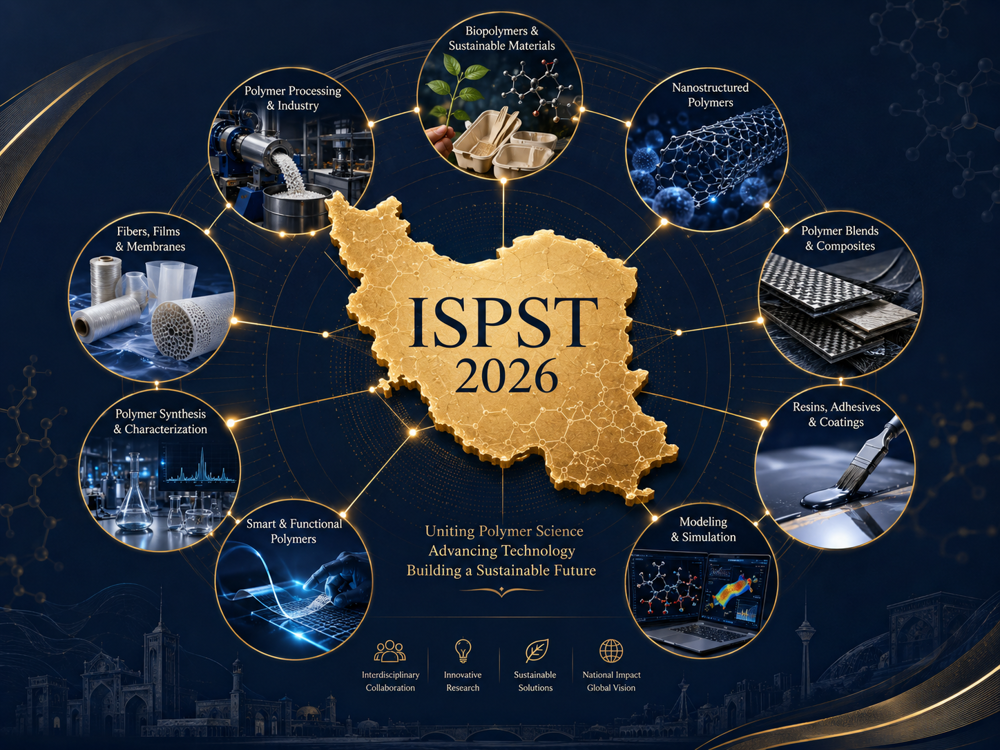
In its earlier editions, ISPST mainly focused on fundamental and applied topics in polymer science, polymer chemistry, polymer engineering, processing, material properties, and the relationship between academic research and industrial needs. Over time, as polymer science and technology expanded, the scientific scope of the seminar also developed. Topics such as polymer composites, nanocomposites, biopolymers, polymeric membranes, rheology, synthesis and characterization, smart and functional polymers, modeling and simulation, sustainability, and novel polymer applications became part of its scientific program.
The continuous organization of ISPST in different cities of Iran, from Tehran and Shiraz to Isfahan and Tabriz, highlights the seminar’s role in connecting the national polymer science community. Throughout its history, ISPST has aimed to provide an environment for presenting new research, discussing scientific and industrial challenges, introducing emerging technologies, and strengthening collaboration among universities, industries, and research centers.
The 16th edition of the seminar was held in 2024 at Sahand University of Technology in Tabriz. With broad participation from researchers and a significant number of scientific papers, ISPST 2024 further confirmed the position of this event as one of the major specialized gatherings in polymer science and technology in Iran.
The 17th International Seminar on Polymer Science and Technology, ISPST 2026, continues this scientific tradition. Building on several decades of experience, this edition aims to provide a platform for knowledge exchange, presentation of research achievements, development of academic and industrial collaboration, and discussion of emerging topics in polymer science and technology.
In ISPST 2026, in addition to the main scientific themes of polymer science and technology, special attention is given to Artificial Intelligence Applications in Polymers and Circular Economy in Polymers. These special topics reflect the seminar’s future-oriented approach toward advanced technologies, sustainability, resource management, and the growing role of data-driven methods and artificial intelligence in the development of advanced polymeric materials.
ISPST 2026 represents the continuation of a scientific path that began in 1986; a path dedicated to strengthening the scientific and industrial position of polymers, connecting research with application, and creating opportunities for collaboration between the academic and industrial communities.